
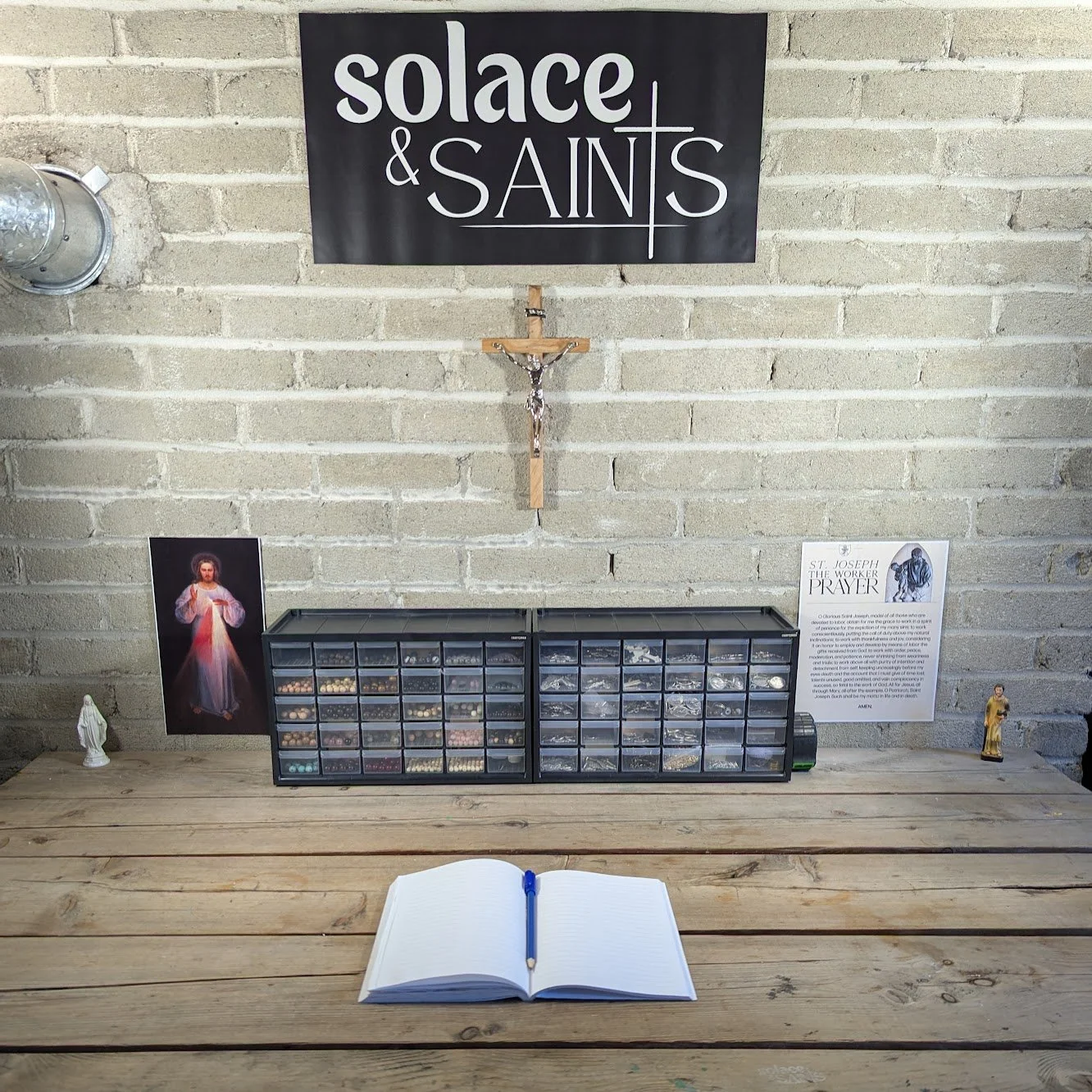
How Solace & Saints Began
During my conversion process, I picked up a Rosary from a local parish. Unfortunately, more often than not, I would pull it out of my pocket to pray and it would come out missing a Crucifix. I thought, “I wonder if I could make one…”
As we have just celebrated our first birthday as a company, I want to share a little bit about how Solace & Saints began.
It all started with a broken Rosary
During my conversion process, I picked up a Rosary (by donation) from a local parish. Unfortunately, more often than not, I would pull it out of my pocket to pray and it would come out missing a Crucifix. After repairing it a few times, I started looking into getting a more durable Rosary. I spent some time looking and kept running into exchange rates and huge shipping fees. So I thought, “I wonder if I could make one…”
Likewise with Crucifixes, I could never find what I was looking for. So I decided to make one myself. During this time, I was working in the construction industry doing finishing carpentry. It was here that I honed my woodworking skills and refined my detail work. It’s remarkable to look back now and see how God was preparing me for what was to come.
My first handmade Rosary
After a stop at a local bead shop, where the woman working taught me how to tie a barrel knot, I was about to embark on my first handmade Rosary. Little did I know then, not my last one! I used the beads from the Rosary I already had and was quite happy with the result. I remember the next one I made (or rather the next two) was for a friend (I also made myself a matching one). It had sandalwood and black onyx beads, strung on black 95 paracord. It was there, after countless hours drilling and cracking beads, that I learned I needed large-hole beads next time.
From there I made many more for gifts, and more for myself, all the while refining the craft and learning what I liked and didn’t like, what colours worked, what materials felt good in the hand. I was really loving doing it and would look for any excuse to make one for someone else, or for myself.
I recall saying to my wife countless times, “I wish I could make Rosaries and Crucifixes for work…” It just never seemed like something that was attainable or practical. There was a particular time when work was a bit slow, and I found myself with a lot of time off. I started talking with my wife about making this sacramental hobby more legitimate. So we brainstormed and came up with a name, landing on Solace & Saints.
Why Solace & Saints?
The simple definition of solace is ‘comfort or consolation in a time of distress or sadness’. For me, something I have cherished so much since becoming Catholic is the tangible and tactile elements of our faith. Gazing at a Crucifix or running Rosary beads through my fingers, these simple things, these real things, bring me comfort. I find solace in them. And our blessed Saints; how great a gift they are to us! I don’t know what I would do without Our Lady and Saint Joseph. Their presence in my life has helped me know God more fully, overcome trials with strength, and desire to become the husband, father, and worker God has created me to be.
Dream come true
When our fourth baby was born in the summer of 2024, I took a full year off from work. As time went on it became clear to us that I wouldn’t be returning. With my wife’s business, four kids and homeschooling, me working full-time as a foreman just wasn’t sustainable. So once again, I was a full-time stay-at-home dad (St. Joseph, pray for me!). As things settled a bit, post-baby, I began slowly spending more time designing and sourcing parts and by fall 2024 I was ready with designs and a website. All of a sudden, my dream had come true. I was actually doing the thing I wanted and prayed I could someday do.
I am so grateful to God for Solace & Saints. I am also so thankful for the support of my wife, Brooke, who truly believes in this company more than me! May God forever be praised and glorified, may the Blessed Virgin be honoured, and may the hands of Saint Joseph make great everything we do. Amen.
I will leave you with a prayer to St. Joseph the Worker that I say every day before I work.
O Glorious Saint Joseph, model of all those who are devoted to labor, obtain for me the grace to work in a spirit of penance for the expiation of my many sins; to work conscientiously, putting the call of duty above my natural inclinations; to work with thankfulness and joy, considering it an honor to employ and develop by means of labor the gifts received from God; to work with order, peace, moderation, and patience, never shrinking from weariness and trials; to work above all with purity of intention and detachment from self, keeping unceasingly before my eyes death and the account that I must give of time lost, talents unused, good omitted, and vain complacency in success, so fatal to the work of God.
All for Jesus, all through Mary, all after thy example, O Patriarch, Saint Joseph. Such shall be my motto in life and in death. Amen. (Composed by Pope St. Pius X)
Thank you for joining me in this reflection. If you have been encouraged by what we are doing, please show your support by subscribing to our newsletter and following us on Instagram.
Peace in Christ,
Jesse Cameron
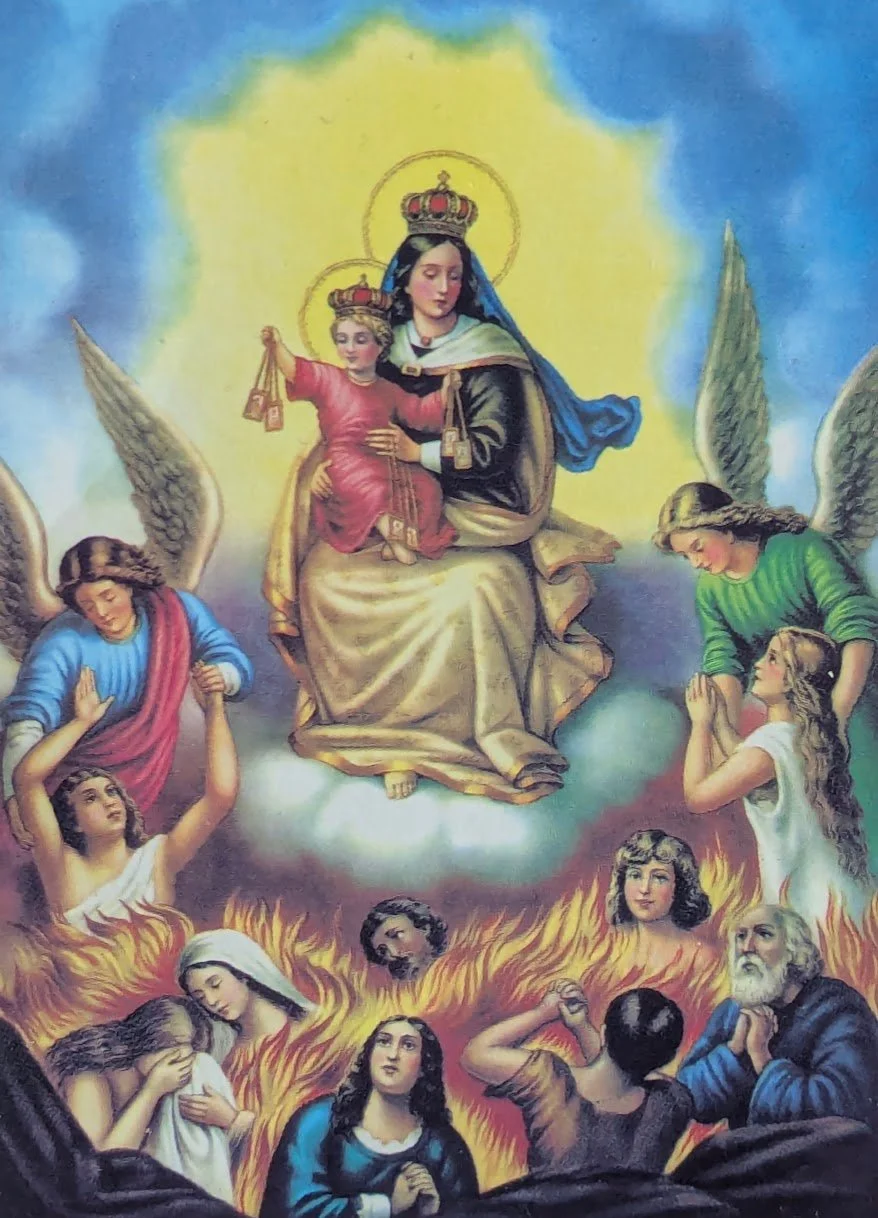
Purgatory: Mercy After Death
I will attempt here to share what I have learned about Purgatory, which has helped me see it as an extension of God’s mercy after our life ends rather than a mere scare tactic to make Catholics behave better.
Facing Difficult Catholic Teachings
One of the benefits of being a convert to the Catholic Faith is that I had to face all the teachings of the Church and wrestle through them as I discerned converting. I wonder if cradle Catholics, because of poor catechesis, can unintentionally remain ignorant of some truths of the Catholicism, something I am very mindful of now as I raise my four young children in the Faith. The first hurdles for me were the Real Presence in the Eucharist and Mary. Once I came to see those as truth, everything else started to click. Purgatory, however, was still gnawing away at my doubt. I chose to trust God and keep going in my conversion.
What I Have Learned About Purgatory
I will attempt here to share what I have learned about Purgatory, which has helped me see it as an extension of God’s mercy after our life ends rather than a mere scare tactic to make Catholics behave better.
As a Protestant, my understanding was that once we believe that Jesus died for our sins, we are forgiven and therefore made perfect, and we will go to heaven when we die. Something I did not really understand was at what point this perfection would take place and what exactly that would look like. One thing is certain: after I have been forgiven for a sin that I have committed, I am definitely not perfect. There is still healing that needs to take place.
The book of Hebrews says that our God is a consuming fire. I do not know exactly what this means, but I imagine if I stood in His presence as I am right now, I would probably get burned up! There is still much work to do in refining and purifying.
Purgatory is not our fate; it is a fallback plan. If we participate in God’s plan, including embracing all the sufferings and trials He allows in our lives, He will provide what we need to be perfected in holiness. “May the God of peace himself sanctify you wholly, and may your spirit and soul and body be kept sound and blameless at the coming of our Lord Jesus Christ. He who calls you is faithful, and he will do it.” (1 Thess 5:23-24)
Life’s Trials and Sanctification
The question is: do we want to participate in it?
The trials of life purify us. Sufferings, sorrows, disappointments, even the small irritations, all can work for our good. They help us depend on God and not on ourselves. They help us detach from disordered desires and desire God above all, who is our only true source of satisfaction. Life has built-in penance.
Embrace the challenges of life and trust in the process of sanctification. God’s greatest desire is not for us to have a happy, easy life. It is for us to be perfected in holiness so that we may dwell eternally in His presence. We can use the truth of Purgatory as a motive to embrace and persevere through the trials of life. And remember: pray for those in Purgatory now, and hope that if we too end up there, someone will also be praying for us.
Amen.
Thank you for joining me in this reflection. I want to encourage you to pray a Rosary for the souls in Purgatory this month.
Peace in Christ,
Jesse Cameron
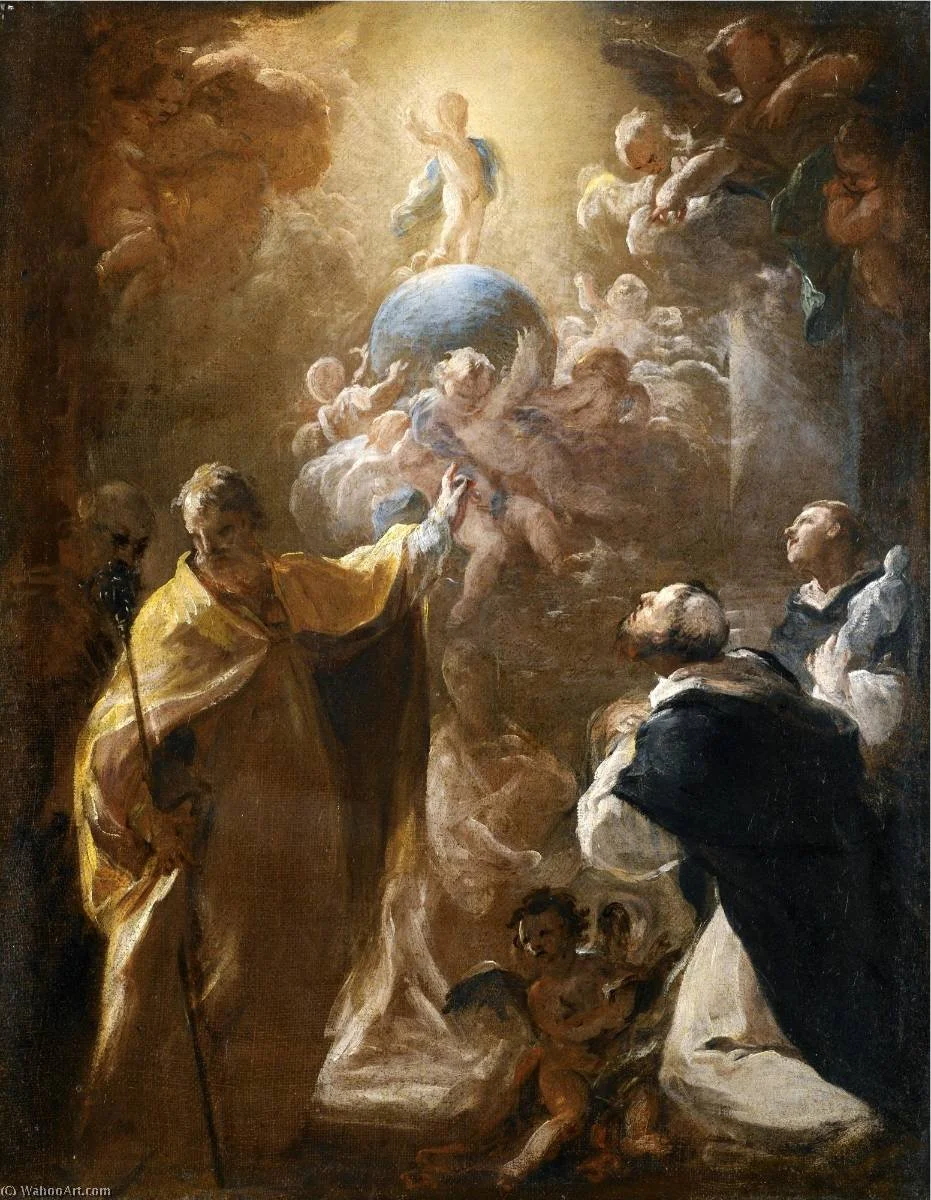
I Believe in the Communion of Saints
…I was thinking about Mary, St. Joseph and all the Saints, and it struck me, “I have a family in Heaven.” I was literally brought to tears in gratitude.
As we have just come out of the celebration of All Saints’ Day, I want to talk about the Saints, our “Heavenly Friends”, as I like to call them…
I remember quite vividly one night, early into my conversion to the Catholic Church, as I was getting ready for bed, I was thinking about Mary, St. Joseph and all the Saints, and it struck me, “I have a family in Heaven.” I was literally brought to tears in gratitude.
As we have just come out of the celebration of All Saints’ Day, I want to talk about the Saints, our “Heavenly Friends”, as I like to call them. I’ll share a bit of background to how this Dogma developed in the Church, as well as some of my personal experience with this sacred connection to our family in Heaven.
What is the Communion of Saints?
The Communion of Saints is a Dogma of the Catholic Church, a truth divinely revealed by God and therefore something we are bound to believe. The Catechism of the Catholic Church (CCC 946-948) describes the Church as existing in three states: The faithful on earth (Church Militant … awesome name), the souls being purified in purgatory (Church Suffering), and the Saints in Heaven (Church Triumphant). This belief emphasizes that we are all in unity in the Mystical Body of Christ as one family of God.
What does this mean for us?
This means that all of those who have gone before us and “fought the good fight” are now perfected through Christ in the very presence and glory of God. They are sharing in the divine life and are therefore given a great ability to help us in our need. A common argument in defending the intercession of the Saints is the question, “Have you ever asked a friend to pray for you?” Most of us, even Protestants, would say ‘yes’ to this. If we ask those still on earth for our prayers in hopes that God will hear them, how much more will God listen to those who are now completely purified in His presence. As St. James tells us in his letter that “the prayer of a righteous man has much power” (James 5:16), here, we can place great confidence in their help.
Do we need the Saints? Can’t God just answer our prayers?
In short, no we don’t need the Saints. God is infinitely more capable of answering our prayers. However, God loves to use His creatures to do His will. It is His desire to share His kingdom with us. Think of His angels who are His messengers, or the Mother of the only begotten Son. Jesus could have come as an adult Man to earth, but He chose to have a Mother and a foster-father. He wanted to use His creatures to participate in His plan of Salvation.
Real-Life Superheroes
Something I love to do with my kids is learn about the Saints. Each one of them, at different times over the years, have been drawn to one Saint or another. What a wonderful example for children to look up to. They really are like real-life superheroes. But their example isn’t just for kids, it’s for people of all ages.
Personally, I have grown a lot in my devotion to the Saints, particularly St. Jospeh. As a father, husband, and woodworker, I have found him to be both an exemplary model and powerful intercessor. St. Teresa of Avila has also inspired me, both in her interior struggle with worldliness and in her deep desire for union with God. I also love her sense of humour. There is a story of her being thrown off a horse into the mud and she said to Jesus, “If this is how You treat your friends, it is no wonder You have so few!” While it always makes me laugh, it also reveals a beautiful and raw honesty in her relationship with the Lord.
And the list goes on. Over time, God has drawn me to many Saints, each one teaching me or encouraging me in a different way. What a treasury of grace and friendship they are!
Patron Saints & Tips for growing in devotion to the saints
There are an estimated 10,000 Saints and over 1600 that have been formally canonized, so there is no shortage of Saints to choose from. Every Saint is also a patron of something, meaning they are a special guardian of a group, place, activity, or even a thing (like St. Clare is the patron saint of TVs. Wild!).
Personally, I have found it overwhelming how many unbelievable stories there are of different Saints, as well as spiritual practices to glean from. However, I would recommend picking a few Saints that you feel connected to and learn about their lives: the way they prayed, how they lived, the challenges they faced, and how they overcame them.
If we are really open to seeing it, the truth is we don’t choose them, they choose us. God gives them to us to help us, encourage us, and guide us on this pilgrimage of life, as we “press on toward the goal for the prize of the upward call of God in Christ Jesus” (Phil 3:14).
Amen.
Thank you for joining me in this reflection. If you found it encouraging please take a moment and subscribe to our newsletter and follow us on Instagram to stay in touch.
Peace in Christ,
Jesse Cameron
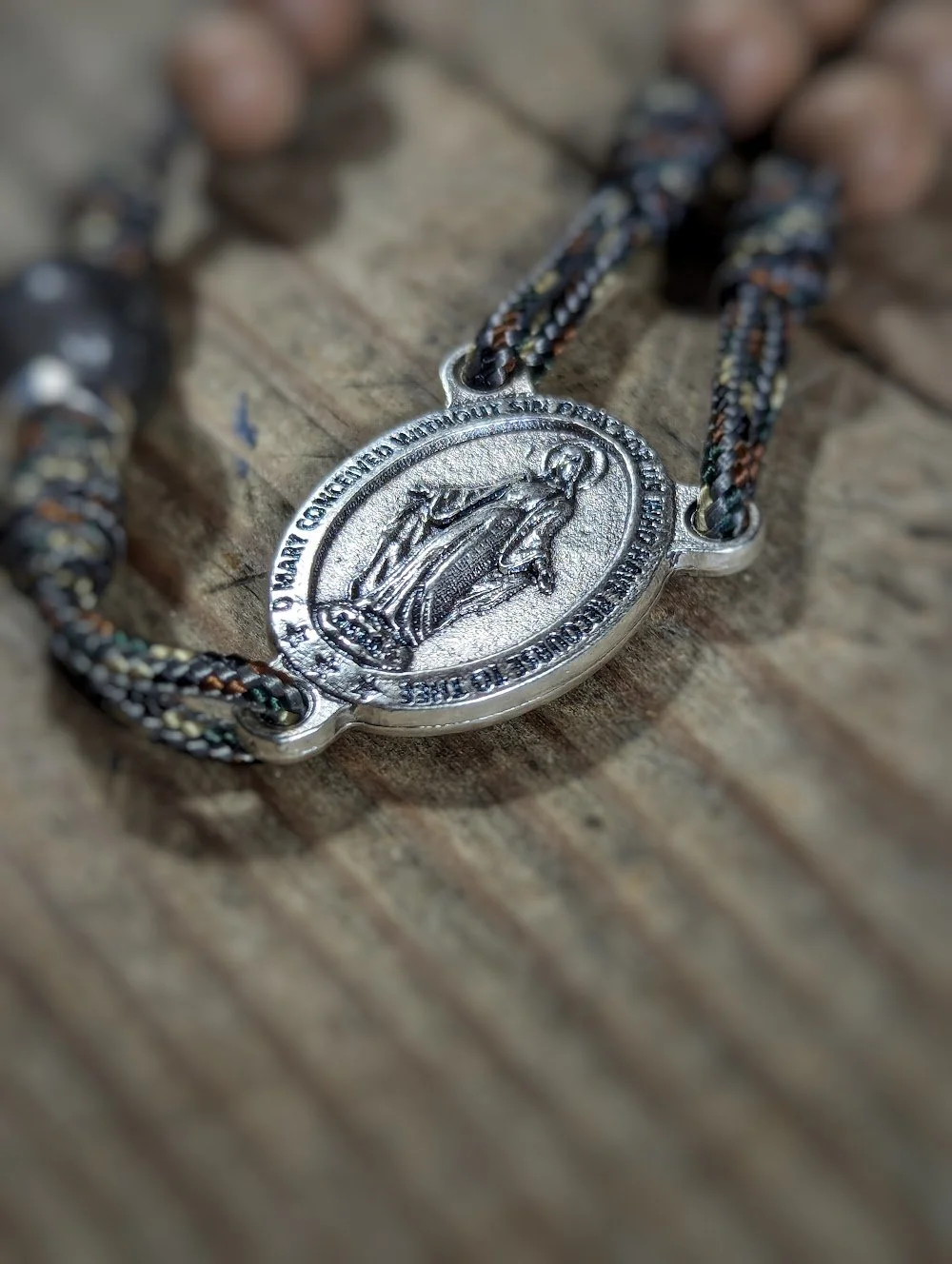
The Holy Rosary
Isn’t the Rosary Just a Marian Devotion?
While the Rosary is clearly a Marian devotion, it is not only such. At its core, just like Mary is at her core, it is Christocentric. “My soul magnifies the Lord, and my spirit rejoices in God my saviour!” This is the heart of Mary…her only desire….
As the month of October, the month of the Rosary comes to a close, I thought it fitting to write a bit more on this beautiful prayer that has, over the centuries, become a pillar in our Catholic Faith.
I’ll start with a brief and simple history of the Rosary, and, as my wife always says when I try explaining something and inevitably overcomplicate it, “Explain it to me like I’m 5.” So here goes…
A Brief History of the Rosary
In early monasticism monks would pray all 150 Psalms daily as part of their spirituality. The lay faithful, looking to grow in the interior life, would glean from the religious in any way they could, and adapt it to their state of life. Around the 8th century, as most lay people were illiterate, they would instead recite the Our Father in lieu of the Psalms, often keeping track on knotted cords. By the 12th century this was replaced by 150 Hail Marys, or the Marian Psalter as it was known then.
In 1208 The Blessed Virgin Mary appeared to St. Dominic with a Rosary and instructed him how exactly to pray her Psalter meditating on 15 Mysteries from the life of her Son. This was the means by which he was to convert sinners and crush the Albigensian heresy of that time. After successfully preaching the Marian Psalter throughout his life, the devotion diminished greatly due to war, the plague, and loss of purpose and structure in the prayer. Much later, in the 15th century, Blessed Alan de la Roche, through visions of Our Lady and St. Dominic, was called to revive the devotion and started a Confraternity that would eventually be known as the Confraternity of the Rosary. By the early 16th century the devotion to the Holy Rosary had become a central lay devotion.
What Exactly Does “Rosary” Mean?
The term “Rosary” got its name from the Latin word rosarius which can be translated to “garland of roses” or “crown of roses”. Each Hail Mary is like a spiritual rose offered up to Our Lady. So when the Rosary is prayed it is like giving a bouquet of roses to Mary. As beautiful as this imagery might be, it doesn’t suffice in explaining this devotion’s popularity amongst Catholic, lay, clergy and religious alike. So what is so special about this prayer?
Isn’t the Rosary Just a Marian Devotion?
While the Rosary is clearly a Marian devotion, it is not only such. At its core, just like Mary is at her core, it is Christocentric. “My soul magnifies the Lord, and my spirit rejoices in God my saviour!” This is the heart of Mary. This is her only desire. This is her purpose and mission in her life, the life of the Church, and in your life.
In the early days of my conversion to the Catholic Faith, when exploring the Rosary and devotion to Mary, this passage of Scripture from her Fiat kept me grounded in the truth of who she is and what her role is to be in my life. Everything is a means to an end and the End must be God. Mary does not desire to take anything away from Jesus, but rather to take us to Jesus. What did she do upon hearing the great message of the Incarnate Word in her Virginal womb but go “with haste” to share this news with Elizabeth? She quite literally took Jesus to her. Mary always brings us to Jesus.
But Do We Have To Pray The Rosary?
No, we don’t have to pray the Rosary. It isn’t an obligation that we are bound to. I do, however, think that we should pray the Rosary. Why? Because if we don’t pray the Rosary we probably won’t (if we are being honest) spend at least fifteen minutes a day thinking about the life of Jesus; the Incarnation; His ministry; His Passion; the glories of His Resurrection.
“Well, I can read my Bible” you may say. Good, read your Bible every day. And pray the Rosary every day too. Because when we meditate on these Mysteries of Christ we aren’t doing it alone. We are doing it with the one who knew Him best. Who carried Him in her womb. Who shared blood with Him. Who carried His DNA in her body even after He ascended to Heaven. The Mother who no doubt caressed the infant back of the One whom the soldiers scourged. The Mother who kissed the hands and feet of Him who was pierced. The Mother who held the lifeless Body of the One whom she gave a Body to. Who’s Father is Spirit and Mother is flesh. His Mother, who is also, through Him, our Mother.
Holy Mary, Mother of God, pray for us sinners now, and at the hour of our death. Amen.
Thank you for joining me in this reflection. Please subscribe to our newsletter and follow us on Instagram. And please consider picking up your Rosary and praying it today. If you need one we have some available for you in our store.
Peace in Christ,
Jesse Cameron

What is prayer? How do we pray?
What is prayer and how do we pray in everyday life? I explore these questions through my own experience from early life, and through my conversion.
Defined
Webster’s Dictionary defines prayer as “an address (such as a petition) to God or a god in word or thought.” The Catechism of the Catholic Church says prayer is “the raising of one’s heart and mind toward God.”
Prayer can take many forms and be motivated by many intentions: petition, intercession, praise, thanksgiving, worship, and adoration. We can pray alone or with others; with our words, our mind, our heart, and even our silence. It is both complex and simple; easy to neglect, yet so very necessary.
I am by no means an expert in prayer, but I will offer some thoughts and share a few of my experiences as I have explored this great mystery, this wonderful gift that is prayer.
Early Life & Conversion
Growing up in a Protestant home (yes, I am a convert, more to come on that in future blogs) I learned to say my prayers at a young age: mostly before bed and often before meals; when I wanted something from God; when I felt scared; when I knew I had done something wrong and needed forgiveness. These simple, sometimes routine petitions to God, as infrequent as they may have been, carried me through many years of wayward living and worldly pursuits.
I learned to pray more fervently in my early adult life as I started attending a Pentecostal church and practiced spontaneous prayer, particularly in group settings. I learned also to pray with the Scriptures, especially the Psalms. Then, during my conversion, I discovered the great treasury of prayers in the Catholic Church. Though familiar with the Our Father (or Lord’s Prayer, as Protestants call it), I never really prayed it other than reading it in the Gospels. And the Hail Mary, well isn’t that just a football pass?
The Rosary
I was always intrigued by the Rosary though. I think I most often saw it in tattoo form along with some praying hands. Intrigued, but also terrified, much like with imagery of Our Lady, I was captivated, and yet apprehensive. I remember when I got my first Rosary: all black beads, a black wooden Crucifix, and a beautiful little centerpiece of Our Lady with a rose on the back. I carried it in my pocket for a long while before I ever prayed it. I remember, when praying with it for the first time, asking God to forgive me if I was offending Him.
Over the past two and a half years since my conversion, I have picked it up and put it down; prayed it daily, sometimes weekly. Loved it and felt indifferent to it. This month, however, I have committed to praying it daily. I’ve even started praying a decade with my wife and kids before bed. I think (I hope) I’ll pray it every day for the rest of my life. I’ve learned so much about the power of this prayer. I’ve grown so much in love for Mary, our sweet and Blessed Mother. I could, and no doubt will, write an entire blog on this prayer alone. I love the Holy Rosary. I sleep with it in my pocket or in my hand every night.
Everything As Prayer
St. Paul tells us to pray without ceasing. In the literal sense, this seems impossible. But as I have opened up my mind to God’s presence and His desire to meet me in everyday life, as a husband, a father, a business owner, a son, I am starting to understand that everything is a prayer. When I’m with my family, when I’m working, in silence, in suffering, in impatience, everything can be offered up as a prayer. I guess, in some ways, I’m saying that prayer is a perspective.
So perhaps the question is, “What isn’t prayer?”
Thank you for joining me in this reflection. If you’d like to keep in touch, please subscribe to our newsletter and follow us on Instagram.
Peace in Christ,
Jesse Cameron